
Core Concept: Organizational Health
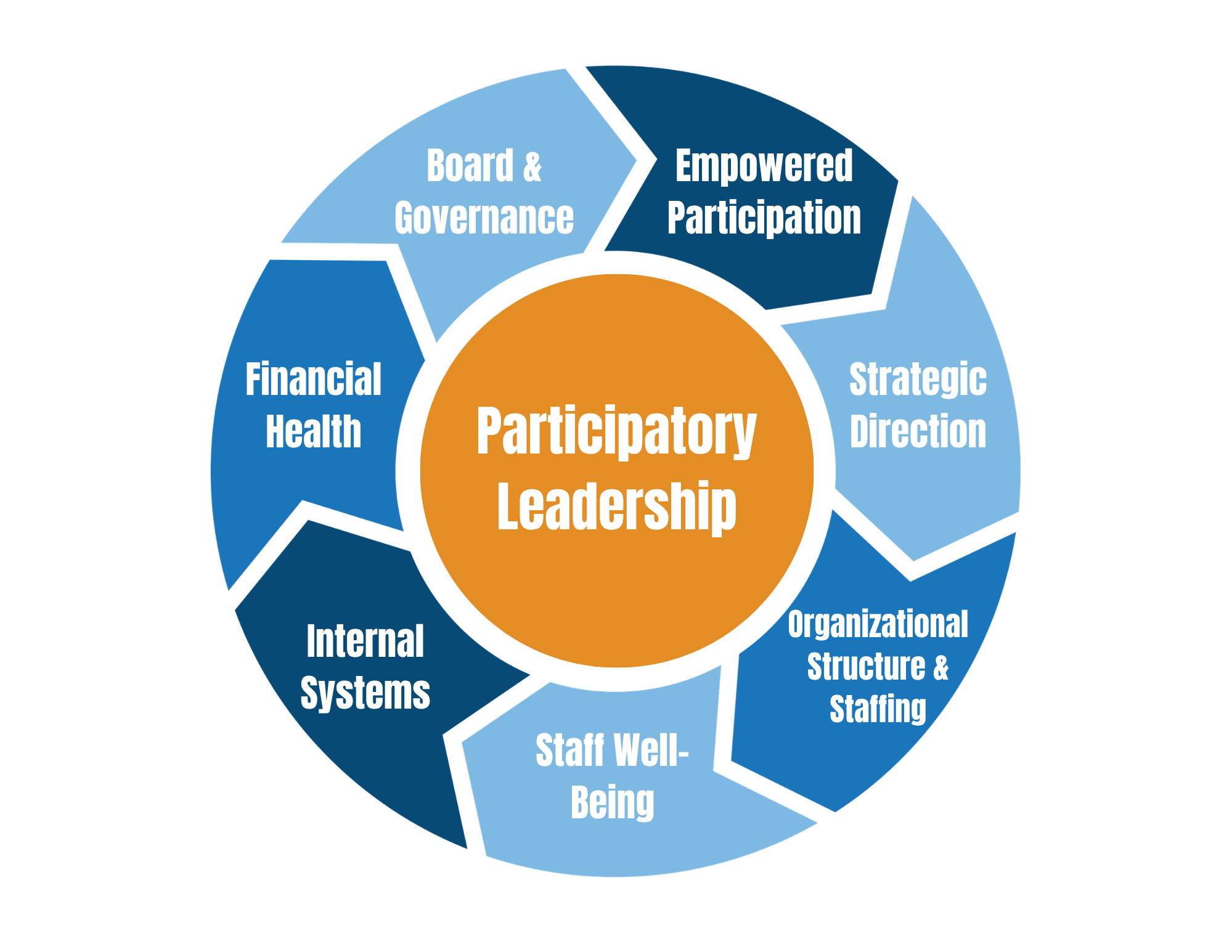
Organizational Health Framework: All eight components are important to organizational health, with Participatory Leadership practices at the center.
Organizations today are being asked to do more under conditions that are harder to predict than in recent memory. Funding can shift with a single policy change or funder decision, community needs are growing faster than many organizations can keep pace, and the people doing the work are stretched thin. In this environment, an organization’s health - not just its programs or its plan - determines whether it can adapt and keep delivering on its mission. Research by McKinsey & Company points to organizational health as one of the strongest overall predictors of organizational performance and long-term resilience, a finding that matches what we have seen in more than 20 years of working alongside rural changemakers across Central Appalachia and beyond.
Based on our work with partners and clients across rural Appalachia, we at RSP have identified eight interconnected elements of organizational health. These elements don’t constitute a generic checklist. They were developed for the unpredictability and uneven footing most organizations face today, with particular attention to organizations working to make change in rural communities and serve rural populations. Each element focuses on cultivating an organization that can account for disruption, adjust as needed, and stay anchored in its mission, rather than one optimized only for stable times.
What is Organizational Health?
Organizational health is more than setting and achieving goals. A helpful way to think about it is to picture the organization as a living system. A healthy living system continuously regulates and adjusts as conditions outside it change, keeping its internal environment stable. The ability to adjust without losing footing is exactly what unpredictable times demand. Organizations are as complex as any living system, but they have identifiable indicators of health, and those indicators can be strengthened.
Health, in this sense, is not a fixed state anyone can reach and hold onto; it is an ongoing capacity to respond, which is why it matters most when conditions keep changing.
Why is it Important?
For organizations serving rural communities, where alternatives are few and the people you serve often depend on you, the cost of an organization faltering is felt directly in the community.
In the for-profit world, organizational health is often framed as a competitive advantage. For nonprofits and social enterprises, the stakes are different: health determines how effectively and efficiently the mission is achieved, and whether the organization can stay responsive when the environment around it shifts. When funding, policy, or community needs change quickly, a healthy organization can adjust without losing sight of its purpose or burning out its people.
Building a regular, organization-wide health practice makes an organization more resilient, helps it retain staff and attract people who share its values, and, most importantly, keeps it moving toward its mission and vision.
What Are the Eight Elements?
It is rare for all eight elements to be fully in place or perfectly aligned, and that's expected. What matters is that organizations assess them and keep returning to them as conditions change. Attending these eight elements is what allows an organization to sustain its work, and its ability to serve rural people and places, over the long term. Finally, think of the elements as a set. Because they reinforce one another, strengthening one often makes the others easier to strengthen, which matters most when time and capacity are limited.
Participatory Leadership
Executives and supervisors make participation part of how they lead. They involve people meaningfully in decisions, build a culture of trust and collaboration, and act in line with the organization's values. As we noted in our previous post, effective participatory leaders are reflective, values-driven, and committed to the empowered participation of those around them. This element is about leaders' choices and behaviors, and it sits at the heart of the model. How leaders involve, trust, and empower people shapes every other element that follows.
When conditions are unpredictable, leaders who have already built the trust and open channels can make hard decisions faster and with more buy-in, rather than trying to build both in the middle of a crisis.
Empowered Participation
This element looks at the same dynamic from the other side. Participatory leadership is what leaders do; empowered participation is what people at every level experience and do in response. Empowered participation ensures that the organization is full of leaders. Staff have the resources, authority, and encouragement to share feedback, take initiative, and lead within their roles. That participation extends beyond staff and ensures that community members have meaningful opportunities to shape the work that affects them. Like the parts of any healthy living system, every part of the organization is connected to, and supports the others.
When leadership is shared, an organization can respond quickly to change without waiting on one or two people, and its activities are better coordinated. When shifts and transitions occur, they are far less destabilizing, because leadership does not rest with only a few people. This matters especially in rural organizations, where a few people often wear many hats.
Strategic Direction
The healthy organization has a clear sense of purpose and shared priorities, both internally and in the communities it serves. Its strategic roadmap is well defined, easy to understand, and adaptable as conditions in the wider world shift. Just as important, the roadmap stays alive in daily work: a clear work planning process links annual objectives and three-month priorities back to the roadmap, and regular check-ins keep teams focused on what matters most and how they're progressing.
In unstable times, a roadmap that can flex without losing its purpose keeps people aligned when priorities shift.
Organizational Structure & Staffing
The healthy organization's structure and operating models are equitable, clear, and relevant to carrying out its mission and achieving its vision. Everyone understands how communication flows, who has decision-making power, and where authority and responsibility sit. A clear operating structure (i.e how teams meet, share information, and coordinate) helps work move smoothly across the organization
Just as important, the organization has the right people in the right roles, in numbers that match the work. Roles and responsibilities are well defined, workloads are realistic, and thoughtful approaches to hiring, onboarding, and succession mean the organization does not depend on any single person to keep going.
Staffing is often where unpredictable conditions show up first - through funding shifts, turnover, and unfilled positions. Clear roles and built-in backup capacity, such as cross-training and coverage plans, let an organization redirect internal resources and capacity without confusion and compromise.
Staff Well-Being
A healthy organization promotes a culture of equity at every level, from executive directors to supervisors to staff, and prioritizes the physical, social, emotional, and financial needs of its people. Together, these support the long-term sustainability of the workforce, helping the organization retain current staff and attract people who share its values.
As staff carry the weight of uncertainty, attending to their well-being is what keeps them able to adapt rather than burn out when conditions are demanding.
Internal Systems
A healthy organization's internal systems emerge from its policies, procedures, and practices, or how work gets done. They are reviewed and updated regularly, reflect how work actually happens, and set realistic expectations for people. They make clear how things are done, why they are done that way, and how consistency is maintained, from financial procedures to the meeting practices that carry strategic priorities into day-to-day work. People have the technology they need to fulfill their responsibilities, adapted to human use and not the other way around, along with clear guidance on using new tools such as AI and on protecting sensitive information about staff and the people the organization serves. These systems exist to improve people's effectiveness in their work, not just the organization's efficiency.
Systems that are reviewed regularly can be adjusted quickly as conditions change, and clear, shared ways of working keep things steady as people and priorities shift.
Financial Health
The healthy organization has a clear, current picture of its finances and the flexibility to respond to change. It maintains operating reserves, has a meaningful share of revenue that isn't restricted to specific purposes, and draws on a mix of funding diverse enough that losing any single source would not threaten its survival. It knows the full cost of delivering each program, including administrative costs, and budgets grants and contracts to cover it. Leaders keep a close eye on cash flow, anticipate shortfalls before they arrive, and have thought through realistic scenarios, such as losing the largest funder, so they know what decisions they would make.
When funding can shift with a single policy change or funder decision, reserves, flexible revenue, and scenario planning give an organization room to adapt rather than simply react.
Board & Governance
A healthy organization's board clearly understands its role and responsibilities, and how they differ from those of the executive director and staff. With that clarity, the board and executive director can work together with trust, honest communication, and mutual accountability, keeping the organization's mission and vision a shared priority. The board provides meaningful oversight of finances, legal compliance, and risk. Its members bring the skills, perspectives, and community connections the organization needs, and they help open doors to funding, partnerships, and community support. The board also makes time for real conversations about the organization's future, not just routine business.
In unpredictable times, a board with the right mix of skills and trust can support timely, well-grounded decisions, including difficult ones, so the organization receives the right attention and support during times of uncertainty
Conclusion
Like any living system, organizations benefit from regular checkups. Assessing these eight elements regularly helps protect the organization's integrity and resilience, and its ability to carry out its mission and serve rural people and communities for years to come, whatever the environment brings.
The organizational health assessment that follows offers a practical place to begin. It is designed to help you see where your organization is strong, where it needs attention, and where to focus first. When conditions keep shifting, a single assessment goes out of date quickly - returning to this survey regularly over time will help build an understanding of how an organization is adapting, not just where it stands at a certain point in time.
The assessment becomes even more valuable when others take it too. Inviting staff and board members to respond, and then sharing what you heard and what you will do about it, builds trust and shows where perceptions align and where they differ.
