
Core Concept: Leading from the Middle
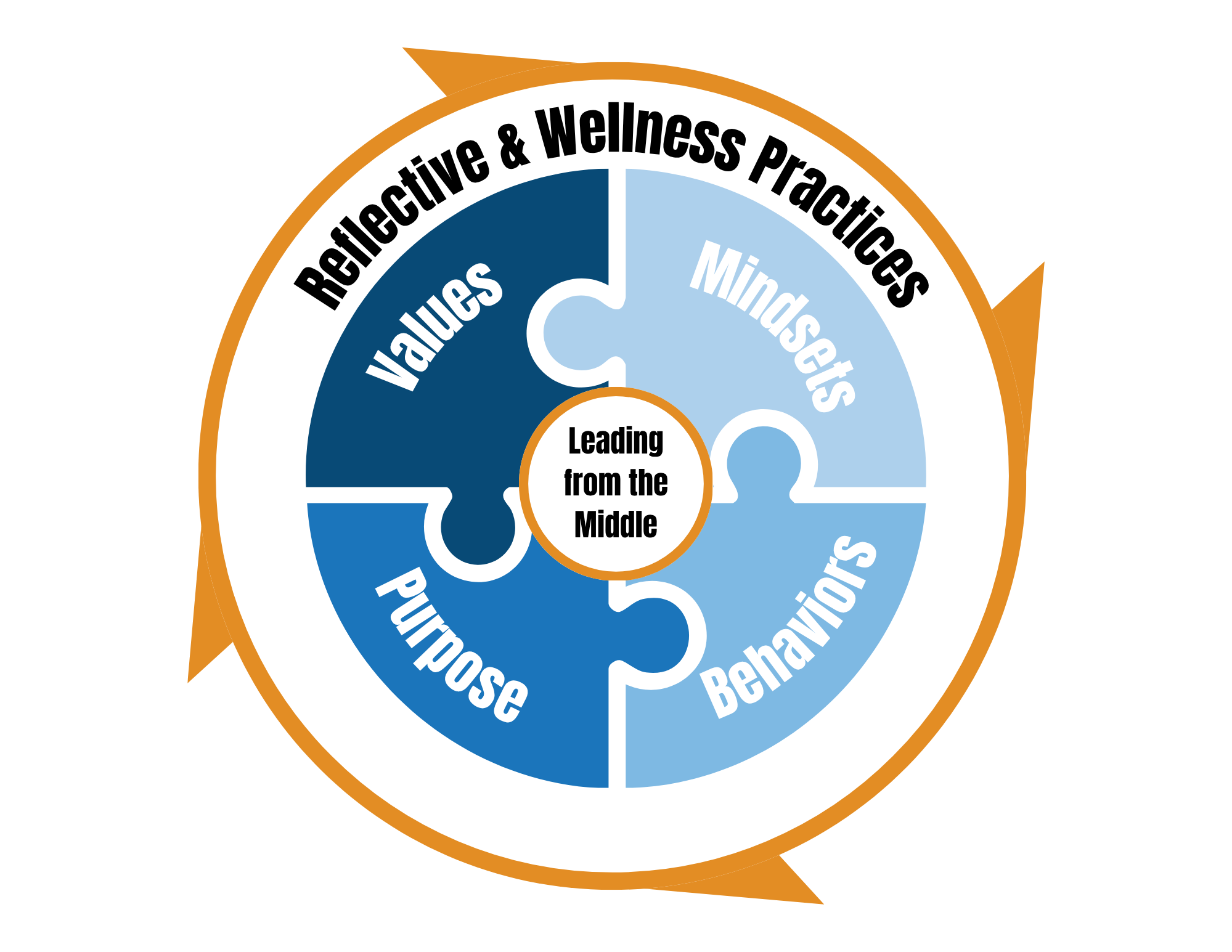
Leading from the Middle Framework: Values, Mindsets, Behaviors, and Purpose are reinforced and maintained through a process of regular self-reflection and self-care.
What Is Leadership?
Leadership is often confused with authority, position, or power. Many people think leadership belongs to the person at the top of an organization—the executive director, CEO, board chair, or supervisor. But leadership is not defined by a title.
Leadership is about how we show up, how we live out our values, how we bring out the best in others, and how we help people move forward together toward a shared purpose.
At its core, leadership is the practice of creating the conditions for people to thrive. When those conditions are present, people and teams are able to do their best work, build meaningful relationships, solve problems together, learn and grow, and contribute to something larger than themselves.
Because leadership is about creating conditions rather than exercising authority, it can come from any level of an organization. It can come from a CEO, supervisor, program manager, frontline staff member, or anyone who helps others thrive and succeed.
Leadership and Management: What's the Difference?
Leadership and management are closely connected, but they are not the same thing.
Management is about getting work done. It provides the structure, systems, processes, and accountability needed to carry out a project or your organization's mission. Good management helps teams stay organized, focused, and productive.
Management focuses on the what:
What needs to get done?
What are our priorities?
What outcomes are we trying to achieve?
What measures will tell us we are succeeding?
What resources do we need and where will they come from?
What roles and responsibilities are required?
What processes and systems are needed to support the work?
Leadership focuses on the how:
How do we build trust and mutual accountability?
How do we communicate and make decisions?
How do we create a healthy team culture?
How do we help people learn, grow, and succeed?
How do we work together toward a shared purpose?
Management creates structure, clarity, and accountability. Leadership creates the conditions for trust, connection, learning, motivation, and shared commitment to emerge.
The most effective managers are also good leaders. Likewise, the most effective leaders understand the importance of good management.
What Does Effective Leadership Look Like in Central Appalachia?
For more than twenty years, Rural Support Partners has worked alongside hundreds of leaders across Central Appalachia and other rural communities. Some have been executive directors and CEOs. Others have been supervisors, program managers, team leaders, frontline staff, and community leaders.
Over time, we have learned from both effective and ineffective leadership. We have seen leaders build healthy organizations where people thrive, and we have seen leadership approaches that create confusion, disengagement, and burnout.
As we reflected on what consistently works, patterns emerged. The most effective leaders were not necessarily the people with the highest title, the most authority, or the loudest voice. Instead, they focused on building trust, developing people, creating clarity, fostering collaboration, and strengthening relationships. They balanced confidence with humility, invested in others, and focused on the long-term health of their teams and organizations.
Most importantly, they understood that leadership is not about being at the top, out front, or having all the answers. They led from the middle.
Leading From The Middle
Again and again, we found that effective leaders focus less on directing people and more on creating the conditions for people to participate, contribute, learn, and lead.
People who lead from the middle understand their role is to help others see their strengths, solve problems together, and grow into their full potential. The result of this type of leadership is empowered participation among the people around you.
When people are empowered to participate, they do more than complete tasks. They contribute ideas, take ownership of their work, help shape the future of their team or organization, and become active partners in its success. As a result, they are more likely to:
Recognize their strengths and what they contribute to the team.
Feel that their ideas, perspectives, and experiences matter.
Feel welcomed, respected, and included.
Have opportunities to contribute to decisions that affect their work.
Ask questions and remain curious.
Build trusting relationships with others.
Take initiative and responsibility.
Work together to solve problems and achieve shared goals.
Over time, we have reflected on what allowed some leaders to consistently create the conditions for empowered participation to emerge. As we thought deeply about our work and the leaders we worked alongside, we noticed common patterns in how effective leaders thought, acted, and showed up for others.
Skills, tools, and techniques are important, but they are not the foundation of leading from the middle. What set these leaders apart was the internal clarity that guided how they showed up, made decisions, and worked with others. Their leadership came from within. They were clear about who they are, what they believed, how they wanted to show up, and why the work mattered. That internal clarity shaped their actions and guided how they made decisions, built relationships, handled conflict, supported others, and ultimately, created the conditions for people and teams to thrive.
Leading from the Middle Framework
As we worked to understand what effective leaders had in common, we realized that leaders who consistently created the conditions for empowered participation shared a common set of values, mindsets, and behaviors. They were also grounded in a clear sense of purpose that provided meaning, direction, and strength to their leadership.
Below is the Leading from the Middle Framework, which captures the core values, mindsets, and behaviors we have observed in leaders who consistently created the conditions for people and teams to thrive.
Values: Who We Are
Values are the principles that guide our decisions, shape our character, and influence how we show up with others. Over the years, we have observed that the most effective rural leaders consistently demonstrate a common set of values. While these are not the only values that matter, they appear time and again in leaders who build healthy teams and strong organizations.
Responsibility: Take responsibility for actions, decisions, and commitments. Recognize that what we do, and what we fail to do, affects others.
Integrity: Be honest, trustworthy, and consistent in words and actions. Align what we say with what we do.
Humble Confidence: Lead with confidence while remaining open to learning, feedback, and the perspectives of others. Understand that leadership does not require having all the answers.
Courage: Act on what you believe is right, even when it is difficult, uncomfortable, or unpopular.
Mindsets: What We Believe
Mindsets are the beliefs that shape how we see people, organizations, and the work. Across the most effective leaders we have worked with, we consistently see a common set of mindsets that guide how they think, learn, and lead.
Believe in People: Believe deeply that everyone has strengths, experiences, and potential to contribute. Help people recognize and grow their gifts.
Curiosity: Remain open to learning. Ask questions, seek different perspectives, and challenge assumptions.
Focus on Assets and Possibilities: Look for strengths, opportunities, and potential. Build on what already exists while helping people imagine what is possible.
The Long Haul: Remember that we are one part of a much longer story. We inherit work, carry it for a while, and pass it on. Practice patience, learn from those who came before us, and invest in those who will do the work alongside us and after us.
Behaviors: What We Do
Behaviors are how our values and mindsets show up in action. Across the most effective leaders we have worked with, we consistently see a common set of behaviors that help create the conditions for people and teams to thrive.
Listen Deeply: Seek to understand before responding. Ask thoughtful questions and help people feel heard, valued, and understood.
Be a Balanced Person in the Room: Work to understand different viewpoints, navigate differences with respect, and help people find the middle path toward shared solutions.
Note: Being balanced does not mean being neutral. It means staying rooted in your values and purpose while helping people hear one another, navigate differences, and move forward together.
Foster Fair and Inclusive Environments: Treat people with dignity, care, and respect. Create the conditions where everyone has a place, a voice, and an opportunity to contribute.
Co-Create: Involve others in planning, decision-making, and problem-solving. Share information, make room for others to contribute, and help people use their strengths in ways that increase confidence and create shared success.
Purpose: Why We Lead
In our experience, the x-factor that makes Leading from the Middle truly effective is a clear sense of purpose. Purpose is our reason for being. It is the deeper reason we do the work we do.
Purpose goes beyond a job title, position, or set of responsibilities. It gives direction to our values, mindsets, and behaviors and helps us understand not only how we want to lead, but why. Based on what we’ve seen, leaders who lead from the middle have clarity about the following questions:
Why is this work important to me?
Why do I care about the people and places we serve?
What impact do I hope to have?
What future am I working toward?
What is my personal vision for my work, my team, or my organization's work?
Having clear answers to these questions helps us understand what drives us, what matters most, and how our work connects to something larger than ourselves.
Purpose connects to the soul of our leadership. People can see it and feel it when our purpose is clear. It is the fire in our belly. The thing that keeps us going, helps us persevere through challenges, and inspires others to move forward with us. It helps us connect our daily work to a larger sense of meaning and reminds us why the work matters.
When clear values, mindsets, and behaviors are connected to purpose, we understand not only how to lead, but why our leadership matters.
Well-Being: How We Sustain Ourselves
Leading from the middle is meaningful but demanding work. Supporting others, navigating challenges, building relationships, making decisions, and creating the conditions for teams to thrive requires a great deal of energy.
Effective leaders understand that well-being is a leadership responsibility. They know it is difficult to create the conditions for others to thrive if they are not taking care of themselves. They also recognize that burnout, exhaustion, and chronic stress affect not only them, but also the people, teams, and organizations around them.
Leaders who sustain themselves over the long haul pay attention to:
Their physical, emotional, and mental health.
Setting healthy boundaries.
Building and maintaining mutually supportive relationships.
Creating space for rest, reflection, and renewal.
Maintaining balance between work and the rest of life.
Leading from the middle is long-term work. To serve others well, we must also learn to care for ourselves. Healthy leaders help create healthy teams. Healthy teams help create healthy organizations.
Reflection and Learning: How We Grow
Leading from the middle is a lifelong practice, and no leader gets it right all the time. What separates effective leaders from others is not perfection. It is their willingness to learn from their experiences and continually grow. Over the years, we have observed that the most effective leaders consistently make time to stop, think deeply about themselves and their work, and learn from experience.
Self-reflection is the practice of stepping back from the day-to-day work to think deeply about who we are, how we are leading, what we are learning, and what needs our attention. Without reflection, it is easy to become reactive, get stuck in old habits, or lose sight of our values, purpose, and priorities. The most effective leaders we have worked with intentionally set aside time each week or so to pause, reflect, and learn from experience.
For us, journaling is one of the most effective reflection practices. The act of writing helps slow down our thinking, clarify our observations, and deepen our learning. Over time, a journal creates a record of our leadership journey that allows us to look back, notice patterns, and see how we have grown and changed.
At the same time, there is no single right way to reflect. Some people reflect while walking, driving, gardening, exercising, or spending time in nature. The method matters less than the practice. What matters is creating regular space to think deeply, to learn from experience, and to use our learning to grow as a leader.
To support your own reflection practice, we offer the following questions. You do not need to answer every question every week. Instead, use them as prompts to help you slow down, learn from experience, and stay connected to your purpose, leadership, and well-being.
Weekly Reflection Questions
How did I advance my purpose and vision this week?
What were my biggest wins and setbacks?
How did I live into the values, mindsets, and behaviors of Leading from the Middle?
Which ones showed up most strongly, and which ones need more attention?
What other values, mindsets, or behaviors are important in my particular situation, culture, or work?
How did I embody them this week?
How am I doing physically and mentally?
How are my relationships and work-life balance?
What is giving me energy, and what is draining it?
What am I learning about myself, the people around me, and my leadership?
What patterns am I noticing?
Based on this reflection, what are one or two things I need to focus on, practice, or do differently next week?
Over time, reflection helps us become more self-aware, more intentional, and more effective. It keeps us connected to our values, mindsets, behaviors, and purpose. Most importantly, it helps us continue creating the conditions for people and teams to thrive while remaining committed to our own growth and learning over the long haul.
